This article was a very long time in the pipeline. For one reason or another I always postponed it even though I promised to Thomas (who kindly lend me this lens) to write my opinion about it. It might be that I don’t really write about gear which I don’t particularly in love with.
The controversy
I have a love/meh relationship with Lomography. There are products which I absolutely love such as the LomoGraflock 4×5 Instax back and some of their film stocks. In general I am really happy that they are there, form a community and bring more diverse options to photography. But on the other hand I am not interested in funky plastic toy like gear like Holgas. I totally get why they appeal to a lot of people, it is just not my cup of tea. And also I am outright allergic to cringy marketing.
The Achromat lens while being made of glass and metal by its very nature leans into the lo-fi category to me especially with the creatively shaped aperture inserts.
As for why the cringy marketing nerve was pushed for me? The massive decorative text on the barrel of the lens:
Daguerreotype Achromat by Chevalier a Paris 1839
Achromat simply means that the lens is designed to focus two colors at the same point exactly. While this is true that such a lens design was used on the official Daguerreotype cameras in 1839, and that lens was created by Charles Chevalier, this lens is a very far relative to the original one.
The original lens while had the same amount of lens elements and the placement of the aperture was similar was a very different beast. It had a much bigger image circle, the lens elements had different shapes and it was a lot slower. It was also nicknamed as the landscape lens.
By Paul Chin (paul1513); self created; a block diagram of the Chevalier Achromatic Landscape photographic camera lens. (Wikipedia)
In the end, I decided to give Lomography a break on this though as they clearly say that the lens is an Achromat inspired by the original design of Chevalier which is not wrong.
I had to reevaluate my feelings after I realized that the naming of the Lomo Petzval lens did not bother me at all. Could be that my judgment is tainted by the how much I actually like that lens….
So I had some baggage to unpack and process before I have even held the lens in my hands. But let’s see how my opinion shifted after actually using the lens.
My setup
I used my mirrorless digital camera (Fujifilm XT2) with the Achromat. Initially I tested a simple adapter which allows mounting of Canon EOS mount lenses to my Fuji X camera. But because I wanted to experience as much of the image circle with all the lens character that comes with it, I decided to use my EOS to X focal length reducer aka speed-booster.
This setup allowed me to play with the lens very comfortably. Using a mirrorless digital camera means that I could stop down the lens while being able to still see a clear image in the viewfinder as the camera compensates for the darker lens by boosting the signal. Focus peaking and punch in focus was also really useful. The speed-booster helped to combat the crop factor and made the lens a stop brighter while supposedly should not had made any change on the way the lens rendered.
The best setup would had been a native full frame camera with Live view + focus peaking and in body image stabilization. Of course any other setup would be fine including EOS film bodies, though the viewfinder can get really dark once stopped down to any usable aperture.
wide openaround f8
Image quality
The image quality of this lens is certainly a mixed bag. Wide open it is simply terrible, soft and full with all kinds of aberrations. There is no big surprise there, this is after all one of the simplest lens design imaginable.
What is quite interesting though is how much things improve by stopping down. Around f8 the images are kind of OK, but certainly usable with a touch of character. It really is crazy how much can be achieved by such a primitive optical formula if moderate apertures are acceptable for the photographer.
Sharpness
Let’s not talk about it. From f11, it is usable. This is not a lens for critical high resolution use cases.
wide openheavily stopped down
Flares
The lens is not particularly prone to flaring. Less glass-air surfaces means there are less opportunities for internal reflections. Still, it is possible to throw some rainbow flares into the mix. I am not sure if it has anything to do with the lens, the UV filter I used or perhaps the speedbooster played a role.
Moderate aperture around f6.3 No flareSun was just outside the frame. Bit of flaring and loss of contrastI like the soft gloomy effect here
Bokeh
An aspect which I like is the bokeh. The fewer glass elements also means that the background blur is really soft without onion rings, or any other madness produced by complex modern aspherical lenses. Especially in close focus scenarios the bokeh is really pleasing indeed.
I have not played too much with the different non spherical aperture inserts. I am sure they could be fun, but I was more focused on the “normal” image quality.
star shaped aperturespherical aperture
Conclusion
Without a doubt the Achromat is a special lens. It looks apart both from the distance and the images it produces are also recognizable. It is for sure a good conversation starter which can be very useful for street photography.
The lens is well built, no plastic involved and stopping down improves on the image quality dramatically which makes it usable as a normal lens. It is manual focus only, but on a mirrorless camera, nailing focus is not very hard.
Otherwise you can embrace the pictorial nature of the lens which is again something that stands out from the crowd.
Could be a painting
All in all, I think Lomography has achieved what they set out to do with this lens and I it has it’s audience. Am I part of this audience? Not really. While interesting, this lens is not something I would buy. In addition, the fact that I can borrow this lens from a friend any time I need it for a project also eases my urge to get one. I will probably try it again on film in the future.
It definitely raised my curiosity towards other Lomo lenses in the lineup such as the Petzval with it’s crazy swirly bokeh. Hopefully it will take less time to put together an article about that lens.
A second opinion
In order to get a more well rounded review, I have asked Thomas (the proud owner of the Achromat), to share some of his photos taken with this lens.
So far I only have the pictures and I know that he used a mid range film EOS body to take them. I may update the post with more details regarding film stock and maybe even with his thoughts about the lens.
Ilford Pan F 50, wide open
I really like this portrait. Even though it is very soft, potentially even out of focus, it successfully captures an expression.
Ilford Delta100, Lumière aperture plate 4,5
The funny highlights in the bokeh are not obvious upon first inspection, but they provide enough eye candy to move the viewers attention from the subject on a longer look. I think this gives a bit extra kick to this image. It is already a killer shot as it depicts a Cannonet camera.
These abstract photographs are part of a four seasons series. Though to me a bit too far gone, it is hard to argue that they are unique. I have to admit that as a series they kind of work. These ones were shot on Kodak Ektar 100 using the Aquarelle Plates f6.3.
Expired Kodak Ektachrome slidefilm
And finally a psychedelic one. Not sure what is going on with the colors, but I can imagine that temperature control was deliberately sabotaged by Thomas during development for artistic effect. I would certainly consider this lens to produce cover art for goa trance albums.
If I get more context or photos with this lens, I will update the article and I hope that you enjoyed this second set of pictures as much I did. If so, please drop a comment.
Further reading
If you like the Achromat design, I have an article about an old Hungarian box camera called Pajtas here. In case you were interested what can be achieved by a lens design with just 1 extra lens element, check out the article about a Trioplan.
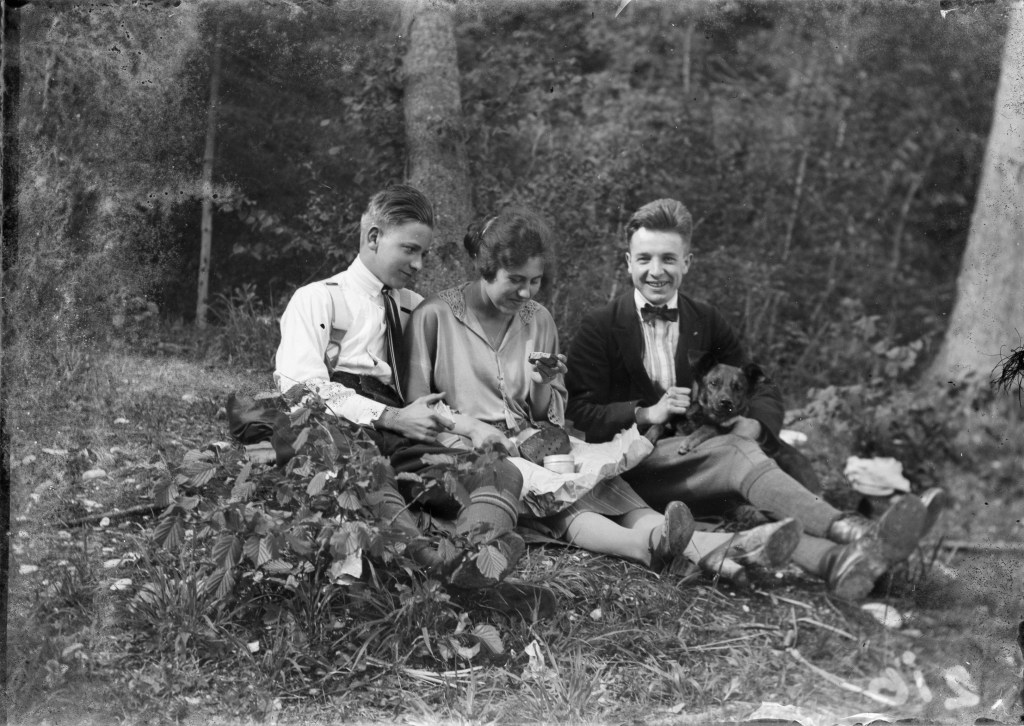
When we take photographs today especially on our phones we don’t consider them as historical documents. Photography is more ubiquitous than ever and for all likelihood our pictures will quietly rot away on a memory card or be deleted during routine maintenance in a dark corner of a nameless datacenter. Maybe they will become part of some AI as a minuscule fragment of the training set but never actually preserved. Besides who really thinks about mundane moments of life like a walk in the park with family as important in a historical context.
But when we take a random sample of 100 years of photographs, chances are that we found them quite interesting.
Of course photography was much less common due to cost, availability of gear and materials and the level of skill needed to take good pictures. People must have thought a bit longer before committing to pressing the shutter. Less photos were taken but those which survived to the present day are more likely to hold something special. The good news is that the medium of film and especially glass plates are quite resilient if kept in reasonable conditions. They are more likely to survive than anything on a hard-drive even though the jury is still out regarding archivability of digital media.
But I am already on a tangent, so let’s have a look at today’s subject which is a lot of 30 6x9cm glass-plates found by my father on a flohmarkt in Hungary.
Each of these photographs are stored in a paper sleeve with some text in German and the date 1923.
Such a find is always exciting to me. Not only that we can admire the quality of such old photographs, but we can get a glance into the past. Of course this is true with any photographs, but the fact that these are literally 100 years old and that the very silver on the glass witnessed these moments somehow makes the experience special.
I enjoy researching old photos and thankfully this time there are many leads to start on. On the paper sleeves there is the date of 1923 as well as the location. In some cases it is just the country, but other times the name of the city or a landmark. It is a bit hard to read the old style handwriting for me, but it seems that the photos are mostly from Germany (München, Herrenchiemsee) and somewhere from rural Hungary as well as a skiing at an unknown location.
The landmarks are easy to identify with the help of Google Image Search and it is real fun to check how these places look like today on Street View. In many cases there are archive photos can be found online from almost exact spots e.g.: feeding pigeons but from different years.
Herrenchiemsee is a complex of royal buildings on Herreninsel, the largest island in the Chiemsee lake, in southern Bavaria, Germany. Together with the neighbouring isle of Frauenchiemsee and the uninhabited Krautinsel, it forms the municipality of Chiemsee, located about 60 kilometres (37 mi) southeast of Munich.
To pinpoint exact locations is a lot harder for these pictures due to the lack of recognizable landmarks. But one sleeve has a text which I read as Csikéria, which is a small village at the south border of Hungary.
One thing is for sure, villages were a lot more different at the time as today. Parts of big cities with a bit of luck have survived largely unchanged the tides of the 20th century, but the rural world is quite a different story. The traditionally built houses made of adobe and covered with straw are gone a long time ago though they start to become fashionable again. There were hardly any infrastructure, only dirt roads, a well to take drinking water and a lonely telephone/power pole can be seen on the pictures. There are no automobiles seen apart from one example in München, but multiple horse carriages.
There is one picture with someone holding a newspaper with the title “A NÉP” (The Folk), but unfortunately there is not much more readable on it.
Clothing is another great source of information. For example there are a handful of pictures of a man wearing military uniform. The demarcations make it possible to identify nationality and rank. I will need to find some help regarding the identification, but it is likely to be a Hungarian uniform.
Skiing
The cross on the peak was/is very typical in the Alps, but it is not possible to tell where these photos were taken. I really enjoy looking at the details of their cloths, accessories such us glasses and pipe and skiing gear. No plastic can be seen here.
Trips and fun
Camera speculations
I would really love to know what camera/lens has been used to take these photos. We know that it took 6x9cm glass plates. It was released before 1923 and most likely by a European manufacturer. It is also likely that it was small and light enough to take it to adventures and shoot it handheld.
I imagine it mast have been a folder style camera from Voigtländer, Zeiss or from a similar brand. Like the Voigtländer Bergheil.
It might be able to guess the he camera model more accurately by the shape of the “film” gate and maybe based on the flare and bokeh characteristics of the lens, but for the time being I am only able to speculate.
Closing thoughts
There are many unknowns around these photographs. We don’t know who they are, if they were living in Hungary and had a chance to visit Germany or the other way around. We do not know what they did for the living. It is clear that they could afford nice cloths, activities such as skiing and not to mention photography.
There are recurring faces, but we have no idea if they were friends, family or anything else. One thing is sure, they were people trying to enjoy their lives in very turbulent times. The first World War was behind them, but they had to face a deep economic crisis and the next big war was just a few years ahead. In any case through these photos we got a little glance into their lives and we can reflect a bit about what has changed during 100 years.
My father told me that he may have some negatives left from the lot he bought. If I can get some more scanned or I manage to find out more about the pictures and there is interest, I may write a follow up to these post. If you’e found this interesting or you have some information (you recognise someone or a place, maybe have a better idea about the camera ), please write a comment.
A photographer is never really putting down his camera, no matter what crazy thing she or he is doing for a living or filling the days with. Since we are not living in an ideal world, most of us have to face the limitation of time and availability of light in our everyday life.
But limitations are not necessarily bad things! They teach us to utilize our possibilities more creatively by forcing us to see and think in ways we would normally not choose to. This, of course, influences our work as well as ourselves and vice-versa. Eventually this feedback loop can contribute our personal and photographic development similarly to the way the ever-changing environment influences life forms and pushing them towards evolution.
Currently, my job is to sit in an office and convince computers to obey to the needs of their human masters. Making their lives easier by sending them nice, well formed and most importantly correct invoices. As interesting as it sounds, but it is somewhat fulfilling to my geek side which likes to brain wrestler with abstract problems.
But it makes my photographer side starve because the current situation has a very little room for photography. Especially now when the winter is coming. Days are shorter and shorter, so more and more frequently I end up to spend most of the hours filled with natural light in between walls in my natural working environment.
To overcome this obvious contradiction, I decided to make occasionally a “bring your giant medium format camera to work day“. I started to bug my colleges and taking portraits of them during lunch brakes or when I need to wait for my computer to finish a long-lasting blocking task.
The point is, you don’t need to stop being a photographer, just because the conditions are not ideal for the kind of photography you are normally up to. Try to get out the most of the situation and who knows this might drive you to completely unforeseen paths and discoveries.
Jogi, Pentacon Six TL, Carl Zeiss Jena Biometar 80mm, Fuji Across 100, Kodak D76, Canoscan 9900F
Jogi is a musician besides being a software engineer and in my opinion, they are making pretty cool music. Their website http://www.theflamingdugongs.at/ is not complete yet, but worth to have a look at.
Barbara, Pentacon Six TL, Carl Zeiss Jena Biometar 80mm, Fuji Across 100, Kodak D76, Canoscan 9900FJanez, Pentacon Six TL, Carl Zeiss Jena Biometar 120mm, Fuji Across 100, Kodak D76, Canoscan 9900FKyrylo, Pentacon Six TL, Carl Zeiss Jena Biometar 120mm, Fuji Across 100, Kodak D76, Canoscan 9900F
Kyrylo was so pleased with his portrait that he visited me at my desk (2 floors below his place) to shake my hands right after I sent it to him.
Hannes, Pentacon Six TL, Carl Zeiss Jena Biometar 80mm, Fuji Across 100, Kodak D76, Canoscan 9900FMarco, Pentacon Six TL, Carl Zeiss Jena Biometar 80mm, Ilford HP5, Kodak D76, Canoscan 9900F
Naturally, it is not my top priority to photograph at work, and I always make sure that this does not have any effect on my everyday responsibilities. It took me quite a while (about 2 months) to get these images. Though they are not perfect, I enjoyed taking them they are part of my journey.
So far I have been writing mostly about classic cameras with full mechanical construction with only one exception the Cosina CSM with an electromechanical shutter. It was because my collection fundamentally consists of such mechanical beauties.
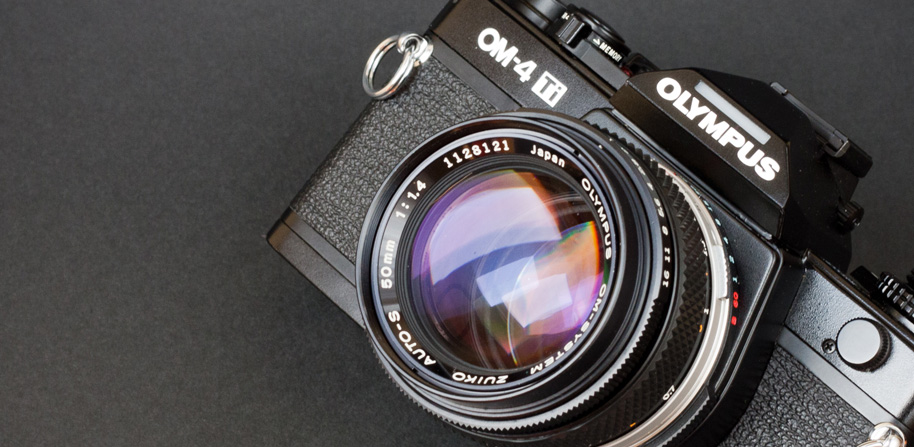
But time goes on and my camera count is also increasing in many unexpected ways. My last camera in the row is still using film and being my camera it is naturally having only manual focus, but it is an ultra-modern professional beast in every other aspect. Ladies and Gentlemen let me introduce to You the Olympus OM 4-Ti!
Olympus OM 4-Ti
Olympus OM 4-Ti (black) Datasheet
Type TTL auto-exposure 35 mm. Single Lens Reflex Camera.
Produced 1989-2002
Film type 24mm x 36mm ISO/ASA 6-3200.
Weight 540g (body only)
Dimensions 87 mm height, 139 mm width, 50 mm depth
Shutter speeds 1s-1/2000s, B, 1/60s can be used mechanically without batteries
Sync speed 1/60s but with Olympus F280 Full Synchro flash up to 1/2000s
Viewfinder dioptric correction; dioptric correction range from +1 to -3 diopters; viewfield: 97% of actual picture field; magnification: 0.84x at infinity with -0.5 diop. (50mm lens)
Exposure meter dual concentric segmented silicon photodiode, Center-weighted and multi-spot-meter (2% of view; 3.3˚ with 50 mm lens) up to 8 points
Batteries Two 1.5V silver-oxide batteries SR44 (Eveready EPX-76) or alkaline manganese batteries LR44
Self-timer 12s delay electronic self-timer
Hot shoe with contact for T series flash; 5-pin connector for T series flash; PC synchro socket.
Motor drive optional motor drive 1 or 2 can be attached, up to 5 frames per second
This camera is the latest model of the one digit (upper grade) line of Olympus OM cameras and in addition, mine is the last sub-version. While the OM 4 was introduced in 1984 my version shown up around 1990. Apart from some extra controls, the body design is pretty much the same as the original OM 1 (1972) which pioneered a new trend of really compact sized SLR bodies. Therefore this camera is one of the smallest reflex cameras ever made taking the 35mm film type.
Focusing
While other manufacturers introduced autofocus in their cameras Olympus stuck to the traditional manual focus design. There is a debate on why, but eventually, to me, the important point is that the lack of AF allowed keeping this wonderful classic shape. The lenses are also very small, there is no need to place a motor into the body, not into any lenses.
Metering
So why is this metering so legendary? Well, apart from the fact that it is reliably accurate it leaves the control in your hand. Other brands like Nikon developed metering systems where the camera compares the scene with a database of stored situations and tries to figure out the best exposure for you. It is convenient and most of the time satisfactory approach, but you have low control over it unless you switch to full manual or you guess what the camera thinks and you can compensate accordingly. It must be said that it is an issue only among challenging lighting conditions.
In contrast, the OM-4 allows you to select up to 8 points of measurements and then the camera calculates the exposure. In other words, you can select what is important for you and what are your priorities. For example, if you take to measurements on the same area and one on another than the first is more important to you than the other.
A back-light situation where both the subject and the background is measured for correct overall exposure. (OM 4-Ti instruction manual)
I know it sounds strange for first, but believe me, it is so much intuitive and joy to use after you tried once. Of course, if you don’t want to get bothered with such evilness, you can still use the traditional center weighted automatics, which just works well in most common situations.
Olympus OM 4-Ti metering and controls
All in all, for someone like me, who works with a very low frame-rate, prefers to think and focus instead of the machine but sometimes likes to get some precise support, this camera is the ultimate choice for 35mm photography. It is worth to note that (as far as I know) some professional medium format cameras also used a similar metering system.
Finally, the OM4 features a highlight and a shadow mode. It is useful in some cases where black or white surfaces are dominating on the frame. Normally if you take a photo with an auto-exposure camera of a gray, black and white piece of paper, it is likely that you will get middle gray on all frames (even instead of the black and white). It is because the metering system tries to achieve an averaged exposure which is good in most cases, but causing troubles when there is no reference. For example, a landscape covered by snow, or documents on white papers are typical cases.
To overcome this, you can use manual exposure, exposure compensation or in this case the high-light and shadow functions. You select the brightest (supposed to be white) or in other cases, the darkest (supposed to be pitch black) area on the frame, push the respective button and you will get the correct exposure with correct white or black representation. In fact, these buttons are doing simply programmed over and underexposure correction.
Flash control
Another interesting aspect is that this camera is one of the first ones able to use flash with very fast sync speeds (up to 1/2000s) when appropriate flash is coupled (like the Olympus F280). The problem of low synchronization speed was common of this kind of cameras due to the construction of the shutter and the very short burst time of typical flashguns. The OM 4-Ti solved this issue by continuous pulse bursts of the flash during the whole exposure which allowed to expose the entire frame correctly, although for the price of limited range.
Durability
This camera is very well made, it is weather sealed and indeed feels solid in my hands. All buttons, switches, and knobs work really definitely and smoothly at the same time.
But how though it is exactly? I have found a really exhaustive description about a crash test done by the Camera magazine 4/’89 (Germany) translated by Wiliam Wagenaar.
The methodology was:
The OM4Ti is stored in the freezer overnight at -20C for 8 hours.
The OM4Ti went into the oven for one hour at a temperature of 75C (Only 50C allowed according to the manual)
The OM4Ti is hung in the grid of the air outlet of a sand blasting company for 2 hours, so that dust, dirt and sand can intrude deep into the mechanics.
The OM4Ti went into a steaming hot shower cabin for on hour.
The OM4Ti went into the shaking machine for a certain time.
The shutter is operated about 15.000 times while the aperture is set at f8.
This camera survived the torture very well, only the cold caused some temporal problems with the shutter. Here are the summarized test results:
Shutter speed error: + 15% for the long times from 1/15 Meter error: none (< 0.1 EV) Spot meter: deviation of 0.5 EV Defects during test: none, except jerky manual film advance Battery use of camera and drive: normal.
Maximum points for each item : 10.
A total of 70 points gives the qualification of “CAMERA MAGAZINE PRO-CAMERA”
Item: Points:
cold test 7
heat test 10
dust test 9
moist test 10
shock test 10
internals 8
price quality 9
ease of use 8
design 8
equipment 8
Total : 87
In comparison, the Leica R6 received 88 points in the same test. If you want to read the full review, please follow this link.
Conclusion
So here is the answer to my question “What is this camera really?”. To me, this camera is a lightweight, compact tool with sophisticated metering and flash control but with the maximum control over exposure and focus possible in an admirable classic shaped yet durable body. It is unlikely that I will take advantage of the flash features, but I can clearly appreciate the excellent metering.
The lenses are very well made and with nice performance as well. Last but not least these cameras are affordable, they used to be called by many as “poor man’s Nikon” in the USA. Nowadays in the digital era, you can definitely find a good deal of an OM camera.
My Olympus OM 4-Ti
I always adored the OM cameras because of their small size, stylish design, good lenses, and reliable construction, but until now I have never even touched one. I came close in dimensions with my Cosina CSM which is really similar at first look, but clearly not in the same league at least with the professional OM cameras.
Olympus OM 4-Ti vs Cosina CSM
How did I get it?
I was not really wanted to get an OM since I had no lenses for the system, plus I was happy with the Cosina as my light travel companion. But one day I walked into a small optics shop which I didn’t know before but I was attracted by the old photo commercials on the front of the building. As it turned out they don’t sell cameras or any photographic types of equipment anymore (they focusing on eyeglasses), but I spot a few old cameras in the cabinet behind the desk.
This OM 4-Ti was among them without a lens, only the body cap was mounted. I asked it out for some inspection and I immediately knew, this camera has a place in my bag. There was no price though, so we had to call the owner of the shop who is around 80 years old and collects cameras as well. We had a nice chat but he couldn’t tell me a price neither. So we agreed to talk about the camera in a few days as he can look after a bit.
Of course, this made me struggling a lot in the proceeding few days as I was not sure that I can afford this camera at all especially because I had no lens. After a few days of hell, I went back to the shop and asked again if they decided the asking price of the camera and they had. The offer was so generous that I bought the camera right away along with some film. The man told me that he likes that I am collecting and using film cameras and I will probably have a good use of it, that is why he is selling the Olympus to me. Of course, I went back to show the camera as soon as I have got this great lens I have mounted on it right now.
Hunting for the lens and focusing screen
Because the camera is in an incredibly good condition and because it is the last evolution step of the professional OM cameras, I decided to get a lens which is matching both in capabilities and cosmetics to the body. I wanted something behind the standard 50mm f/1.8 Zuiko (which is a great lens by the way) especially because I have many f/1.8 fifties for other systems and I really preferred to have something different. On the other hand, I like standards when I have only one lens and naturally, I had a strong constraint on the money to spend.
In the end, I have gone for the Zuiko AUTO-S 50mm f/1.4 lens and I did some research which serial number to look for. It was not an easy search, but I have got my lens on e-bay in perfect shape in the original box with the serial number I was looking for (greater than 1,100,000) that marks the latest design and best coating. For more information about the different variants of this lens look around here.
After I received the lens I had to realize that my focusing screen is good for anything but normal use. The type I had in the camera was made for microscopy and other extreme macro purposes. So I had to look for a replacement focusing screen, but it was not an easy ride. I found many of these on e-bay, but on the price that I started to think if I really did a good deal with this camera. After a few weeks of desperate research, I have managed to find a screen in Hungary at a reasonable price.
Almost 2 months after I first saw the camera in the cabinet I have managed to get a working set which takes photos while I am capable of focusing with it. It cost me way more than I thought when I bought the body, but undoubtedly worth it. This is really an amazing camera to use and hold and I don’t think I would have considered getting one in any other ways.
The way it looks
Personal experience
Until now I shot only 3 rolls of film, therefore it is hard to claim that I master the camera. Nevertheless, the start is very promising as I feel very comfortable and natural to use and the initial results are encouraging as well.
Ergonomics
The ergonomics are really good, although due to the classic shape it is not as convenient to hold as more modern cameras. The bright side is that there is an optional grip available, but honestly, I don’t feel it is necessary. The layout of the buttons and other controls are nice as well, maybe the “highlight” and “shadows” buttons are not the easiest to hit blind, but I don’t think to use them often. The most interesting part of the controls for me is the OM-style shutter speed ring on the lens mount, which is unusual but also brilliant at the same time. You can set both the aperture and shutter speed at almost the same place with the same hand. Of course, it is probably not for everyone, I personally like it.
As I have mentioned already, the camera is really small even with modern standards. It is bigger than mirrorless cameras but it is definitely smaller than any budget DSLR- If you consider that it is a “full-frame” camera than it is quite an achievement.
Operation
Focusing is really easy, smooth and accurate with my fast f/1.4 lens and so far I am very happy with the metering system as well. Most of the time the normal center-weighted metering mode was fine for me with aperture priority mode. Note that aperture priority is the only automatic mode available on this camera, but in fact, this is the mode I prefer on digital cameras the most also. I have tried the spot and multi-spot metering as well with success, but I need more time to gather greater experience with them.
Battery life
I basically I took out the batteries from the Cosina CSM and put them into the Olympus. These batteries were in use for more than a year from now and so far I had no problems. Considering how tiny and cheap these batteries are and how long they last I think this camera is very economical in this respect. I have heard that the regular OM 4 was eating batteries, it seems the Ti version has corrected this issue
Test shoots
I have a Zuiko AUTO-S 50mm f/1.4 lens which has a good reputation in terms of overall image and build quality although it has some barbell distortion. I can confirm all of these statements. The lens is sharp, contrasty, not too prone to flares, the bokeh it produces is also pleasant to my eyes. Indeed the distortion is there, but it is not disturbing unless you shoot brick walls or other well defined geometrical subjects. I may make some measurements and create a lens profile in order to correct this digitally, but as I said this is a minor problem you won’t even notice in the 90% of times. The coating works great and flares are not really threatening you, I think a lens hood is generally a good idea, so I will get one soon.
As for other lenses, I really wish to get some exotic ones most notably the Zuiko 80mm f/2 is my greatest wish for portraits.
Everyone who loves 35mm film photography and needs a light, reliable and stylish companion. It is for everyone who likes to focus manually and prefers full control over metering yet likes to have a sophisticated system to aid the evaluation of exposure times. Last but not least this camera for those who do not mind to keep a pair of small knob batteries in their pockets.
This camera is NOT for:
I don’t recommend this camera for automation junkies, action or sports shooters or in contrast for more conservative people who prefer full mechanical constructions. In the case, if the electronic operation would be the problem, there are plenty of full mechanical choices in the OM series such as the OM 1 or the very rare mechanical counterpart of the OM 4 the OM 3.
omexperience (really cool blog about film OM cameras, OM lenses with deep tests and the OM-D, This site helps you figure out which subversion of a lens has multi-coating etc based on cosmetics and serial numbers)
I admire very much photographers who are able to do street photography of any kind either shooting invisibly or by asking strangers for a photo. Although I love these kinds of photographs I did not dare to do anything like this, therefore. As you have probably noticed already I shoot my friends and relatives most of the times as the same persons appear many times on my blog. All in all, talking to and taking photos of strangers is somewhat natural for some but for most of us including myself it is a challenge.
This is fine actually, but I always try to do new things and find challenges in my photography and the temptation of getting wonderful shots on the street raised so high that eventually I asked someone for a photo and hopefully I will keep doing this practice.
It was easier than I thought, nothing bad had happened, he was very friendly and allowed me to take the shoots below. As you can see he is a musician playing guitar in many places like this underpass I used to walk through regularly.
I know this is not really a traditional street shoot but can be considered as a street portrait similar to those Ade used to shoot with his medium format Pentax and publish on STREET PORTRAITIST blog I really like.
The camera I used is the latest member of my collection an Olympus OM 4Ti with a stellar Zuiko 50mm f/1.4 lens. It was the very first roll of film I moved trough of this little thing and I am quite happy with the results.
Gábor (Szentendre, Hungary), Olympus OM 4Ti, Zuiko 50mm f/1.4, Kodak Gold 200, Canoscan 9900F
Gábor (Szentendre, Hungary), Olympus OM 4Ti, Zuiko 50mm f/1.4, Kodak Gold 200, Canoscan 9900F
Gábor (Szentendre, Hungary), Olympus OM 4Ti, Zuiko 50mm f/1.4, Kodak Gold 200, Canoscan 9900F
After the rather technical post about the true beauty Exakta Varex II, I thought it is about time to come up with something easier to digest. I looked into my photo-stream on Flickr and found these shoots I took back in 2009. I had such a great fun by doing these I decided to share them again here.
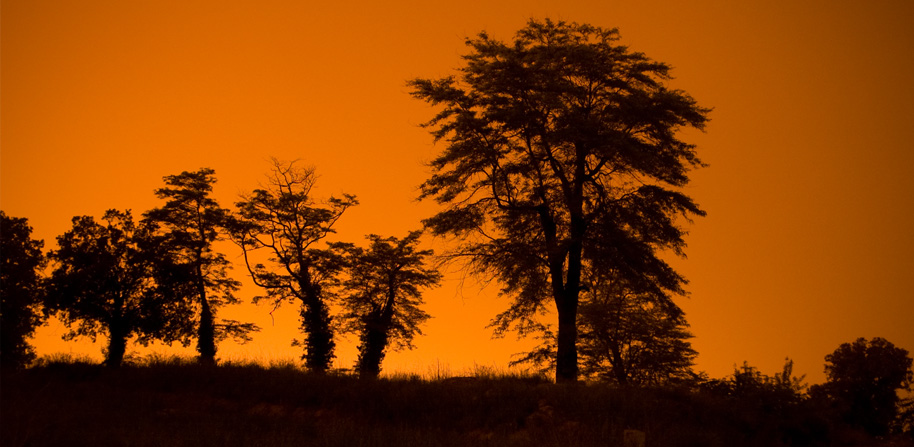
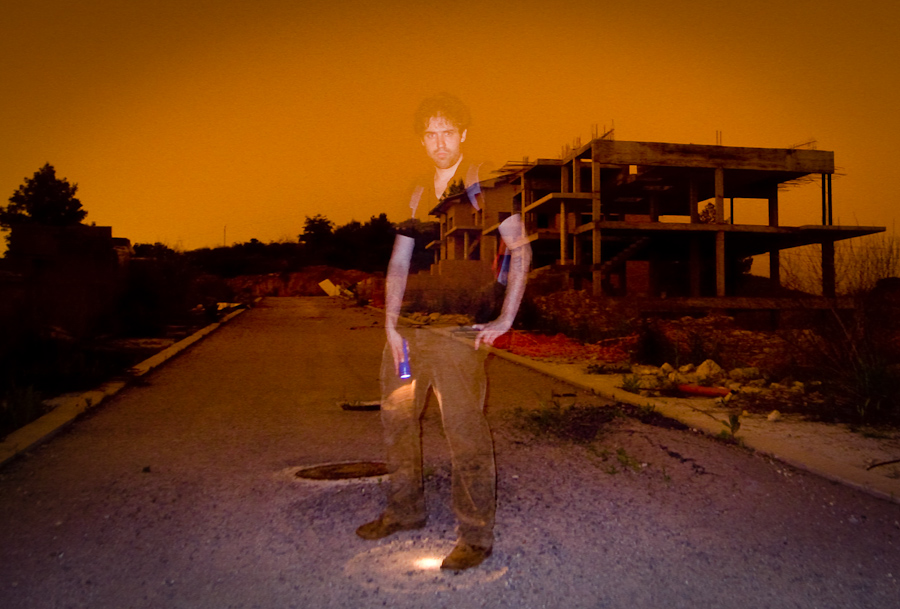
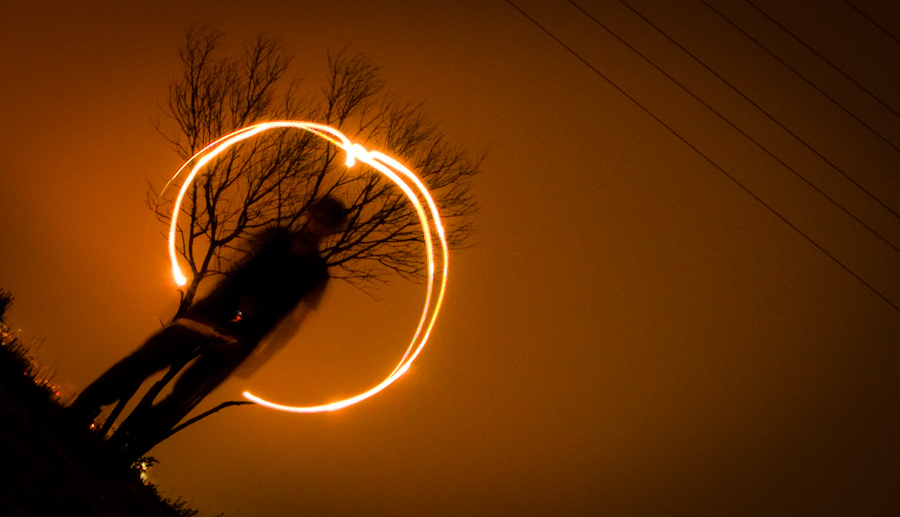
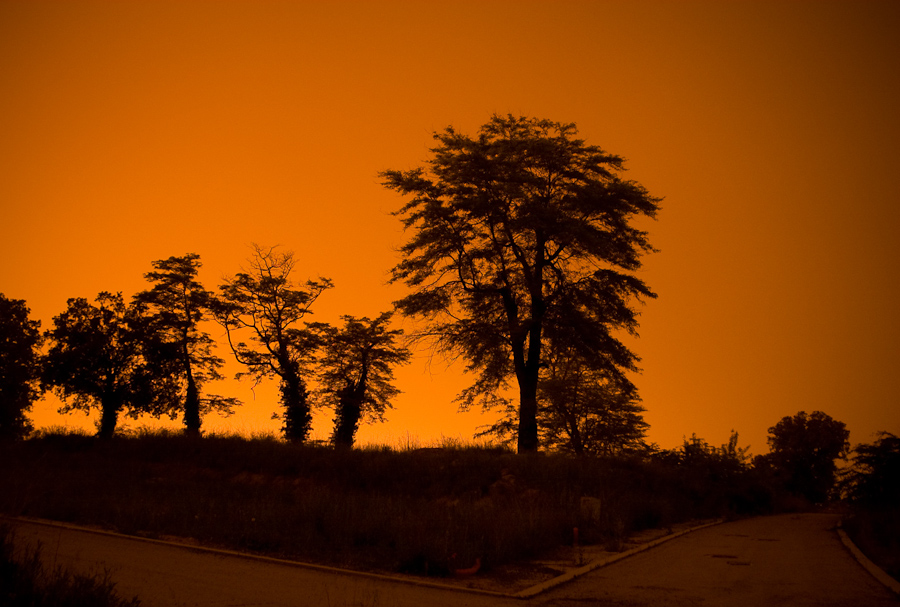
I was in Girona (Spain) and I did many night shoots by the time so I waited for getting dark and I climbed up to a small hill nearby the town. I was pretty much amazed by the colors of the sky painted by the lights of the city. The sky must have been covered by clouds and most of the light was reflected back to earth. This combination resulted this deep orange glow which I liked so much and gave me the sensation of walking on another planet.
In the meantime there was a big celebration in the city because as it turned out the Football Club of Barcelona won an important match that night. Therefore at some point strange sounds, sirens of alarming cars, voices of yelling people and violent explosions of fireworks broke the inner peace of my faithful photographic ritual. I am not a huge football fun so I had no idea what was going on. I thought that these people must had gone crazy down there which increased of my strange experience a lot.
Next day I thought the whole story over and I realized that I was not a tiny bit less crazy than the football fanatics. I was out alone at night on an abandoned construction site relatively far from the city in a foreign country armed with a crap tripod and a compact camera. It sounds not so safe despite the fact that I was not really attractive and the place is generally very calm and peaceful. Well, who is crazy is always just the matter of the point of view, right?
I am a huge fan of post-apocalyptic movies, games, and atmosphere overall. In fact, I really would like to participate or work on such a movie one day. Of course being a mortal I have very little chance to do it, but I had to realize that the receipt of post-apocalyptic scenery is actually very simple.
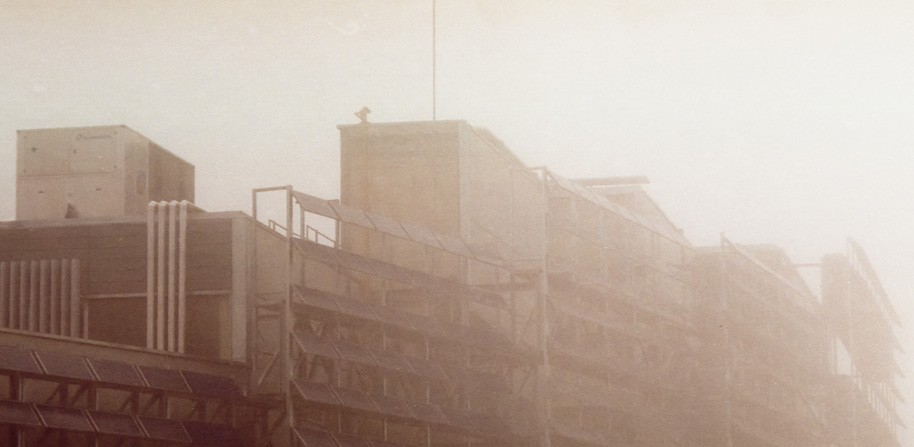
My main ingredients are some early morning mist, a high tech solar cell covered concrete building (very easy to find), an old Exakta loaded with Kodak Gold and 2 vintage glasses (Zeiss Jena Tessar 50mm f/2.8 and Meyer Optic Trioplan 100mm f/2.8).
For some reason, these shoots remind me of the movie Delicatessen which I can faithfully recommend to watch. OK, there aren’t any high tech in that movie, but the fog creates a similar sensation to me at the opening scenes.
This building, by the way, is a member of the Technological Park of the University in Girona in Spain and I am lucky enough to work in this strange complex. I took these photos a morning during my regular walk to work.
Interesting note that this building is named after Narcís Monturiol i Estarriol who invented the first fully functional submarine. Also interesting the fact that (as far as I know) the solar cells were actually never in use even though the construction has finished around 2009. I hope they will be operational one day. I guess there must be a bit expensive for decoration purposes only. I love the way they look like anyway.
























 camerajunky
