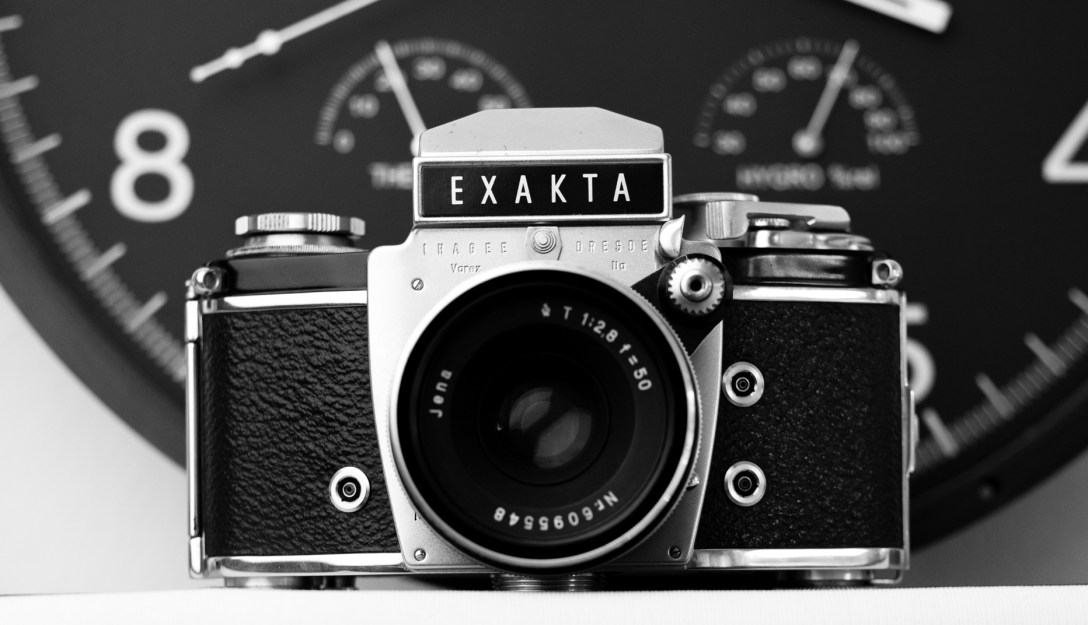

“Woow!” This was the first thing came into my mind when I first saw an Exakta in a cabinet in a very small and messy shop of an old camera-repairman a couple of years ago. The second thing? Well, I seriously considered to lick it quickly while the owner looked away. It never happened due to the glass door of the cabinet and I can still feel the sensation of the missed opportunity -What a pity-.
Apart from the joke, I had been seriously touched by the appearance of this family of cameras, especially the older ones. It is an entirely mechanical, full glass, bare metal, chrome and leather piece of jewelry. I am almost certain that this camera triggered the entire steam-punk culture. There is no doubt that this is one of the most beautiful classic cameras of all times.
“True” Exaktas were manufactured by Ihagee in Dresden during almost 4 decades which resulted in an amazingly complete and comprehensive camera system. While I always keen to give a bit of historical overview of a camera system, I had to realize that others have done this on a level I simply cannot match. If you were interested in the different variants and history, please visit this link. I limit myself to the most interesting facts I found out during my research and consider this post as a kind of tribute to Exakta and the company made it Ihagee.
It is interesting to know that the Exakta camera system was very stable during its evolution, almost all parts were interchangeable among models which are remarkable. There was a huge sort of accessories available for these cameras and they were heavily used for technical and scientific photography. I think this system was one of the most versatile at the time. For example, you can see below a commercial from a 1952 German magazine Die Fotografie where the camera is attached to a microscope.

The Exakta Varex was introduced in 1950 and the big innovation was the possibility to use the camera with the standard waist level finder or with a pentaprism. This interchangeable viewfinder system even further increased the versatility of the camera. In addition, there were a big number of available finders of both types (4 basic pentaprism types) and all of them allowed to use a huge variety of focusing screens on top of it. They claimed in their commercials, that they merged the good old experience with modern ideas. You can check out the complete list of finders and screens on this page.
One of the interesting characteristics of this camera is the left-handed shutter release which (I believe) is inherited from the times when the camera used only waist level finder. It is very awkward at first and even at the second time to handle the camera because of this using the prism for those who got socialized on right-handed cameras. I guess it was no problem initially with the waist level finder and they kept this property. In fact, it is possible to get used to it, but it requires quite a commitment.
Commercials
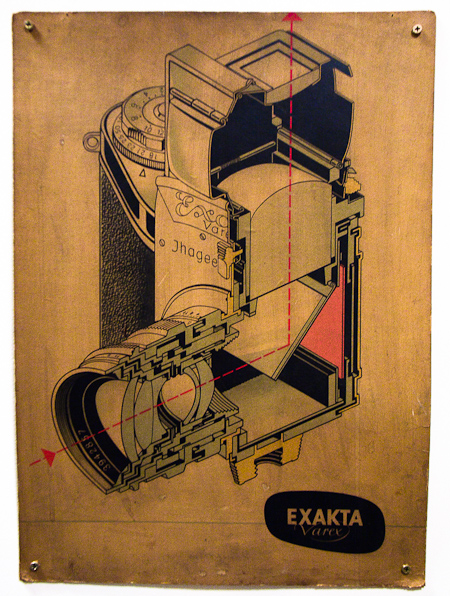
I have managed to dig out a couple of high-quality commercials and posters released by Ihagee, this cool half cut camera poster can be seen in a camera shop in Hungary (Soós Fotó). I have found and included in this post many more nice illustrations from books and magazines. It shows that the Exakta was really among the most prestigious SLRs at the time. It was literally the ultimate way to go for every possible purpose from photojournalism to science and technical applications where larger formats could not be convenient to use.

My Exakta
My Exakta is a subtype of the very long lasting and successful Varex IIa. This version was released in 1960 and the distinguishing feature is the logo which is not pressed into the metal anymore and the shape of the prism is slightly different than earlier models.
Varex IIa datasheet
- Produced 1957-1963 this version was introduced1960
- Film type 135 (35mm)
- Lens mount Exakta mount (inner and outer bayonet)
- Shutter cloth curtain (traveling horizontally)
- Shutter speeds 12s – 1/1000, B
- Sync speed 1/50
- Viewfinder interchangeable waist level or prism
- Exposure meter none
- Self-timer
- PC sync connections
- Internal film cutting blade
This particular camera was sold in Antwerp, Belgium in 1961 and according to the catalog I have, the list price was 13.185 francs with the prism and Tessar standard lens. The second lens (Trioplan 100mm) had the price of 4.205 francs. I am trying to find out what could that mean at that time, but one thing is sure in Hungary this combo would have cost a complete year salary of a regular person in the 60s. In comparison for a Russian Zenit SLR, some had to work like hell for 2-3 months while consuming solar energy only for survival in Hungary those times.
The camera actually belongs to my Friend David who was kind enough to give it to me for use as he did with the Yashica TL-SUPER camera I reviewed. He received it from the original owner from Belgium, so I can actually track back the history of this camera until the beginning. Thank you again, David!
The camera came in the every-ready case, with 2 wonderful lenses. a high-quality B+W filer, a nice rare Carl Zeiss Jena polar filter, a Sunpak flash unit and all sort of documentation including warranty, and catalogs.


Condition and repairs
Lens
The overall condition of the camera is very good, although the Tessar lens was really stiff, it was very hard to focus on. In the opinion of my repair-man, it could have been stored in a cold place for a while. I have got the lens cleaned and lubricated and now it is as good as new. Again, the arts of lubrication was successfully applied, plus apertures and glass elements got some attention and cleaning. Important to note that the focusing ring is covered with some kind of plastic which became rigid over the years, and it is advised to take care of it as it is very fragile and can be broken for any little hit. If it breaks it needs to be replaced by leather with a similar texture which is a hideous task to do.
Shutter
The shutter was advanced when I first got it in hand, so the springs were tensed probably for many years ago and as it turned out the high shutter speeds are not really usable now. 1/500 and 1/1000 while they sound good the movement of the curtains are not even. As a result, some parts of the frame came out less exposed than others. It could be fixed by the master of the lubricants, but it would definitely cost a load of money. I decided to wait and until it gets fixed I started not to use these speeds. It seems everything works fine up to 1/250s and I have managed to carry out my second roll without any problem.
Mirror
The silvering of the mirror is damaged badly around the edges and it has a negative effect on the clearness of the viewfinder. There is no way to fix the mirror because the silver just melted down. The only solution is the complete replacement, but as I use this camera casually only I decided to keep it as it is for a while.
The way it looks


Personal experience
As you have already figured out I like this camera the most because of its appearance. I think it really does look gorgeous even though I prefer more the versions with the engraved or embossed logo on the front plate. Despite this not too serious concern, I feel like holding something really special when I choose this for a walk. For me it is an outstanding experience to carry such a nice piece of history and heritage while I can be almost certain that the camera hanging on my neck is so unique I will probably not meet with anything even close to it. It has its charm and style to not to deny apart from what kind of photos came out at the end. Of course, the shoots are great too, nothing to complain about. What I want to say is that it is so elegant I might walk with it even if it was a bad camera (which is not!).


Ergonomics
Well, we have reached the point where I must stop extol this camera because the ergonomics is at least awkward.
The left-handed shutter release is really hard to get used to it. The shape of the body is nothing but convenient. It is in fact quite bulky. The reason is probably practical though, this shape helps to keep the film more in place and flat according to some opinion and I eventually accept it.
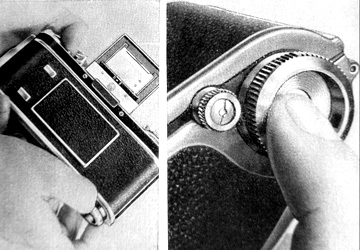
To change the shutter speed, you have to pull out the dial and it is the normal procedure in this era, but not really convenient. To set longer exposures (1/5-12s) you have to operate two dials by setting the main dial to T mode and setting the second for the speed. The film advance lever has an extremely long stroke and the mirror does not return after release. The film transferred from one spool to another in the opposite way as it is usual as the system is left-handed, and to rewind the film you have to pull and turn a couple of things at the same time. Overall many things are a little bit complicated.
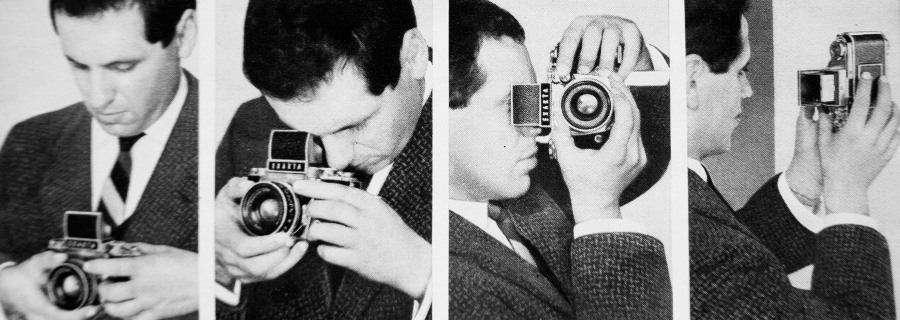
All in all this camera is the hardest to use among those I have ever tried. It is at least challenging and not as straightforward as switching your bicycle. But I think it is worth to fight and it is possible to realize that focusing on your left hand is only a habit, not a testament. After you have learned all the tricks it could be as easy to use as any other camera, but for me, it takes some time.
Proper ways to hold the camera while using the waist level finder. The image is from the original handbook of the camera

Focusing
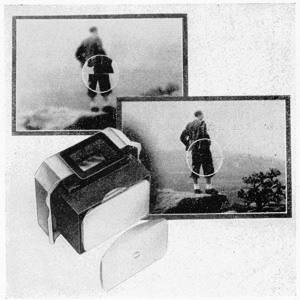
I have only a pentaprism with split screen focusing glass. It is dark for modern standards, although it could be also because my lenses are not exactly that fast (f/2.8) and the mirror is damaged around the edges. I suppose with a faster lens like a f/1.5 Zeiss Biotar and with a new mirror, it would be bright enough.
The split screen works as intended, but it takes a too big part of the screen (in my opinion) and I often use the matte parts around the central circle to focus instead.
I would love to try the waist level finder also because I prefer that on my Pentacon Six over the prism because of the extra lightness and the presence of a magnifying glass for pin accurate focusing. I don’t shoot much action with these anyway, I have time to focus precisely.
Funny feature
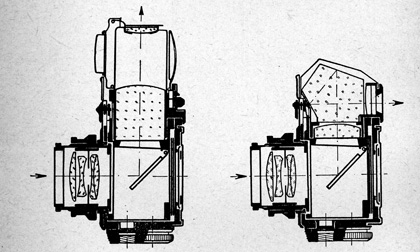
There is a feature of this camera which had been hardly used by most and made me think quite a bit until I have found out what it is for. Interestingly enough you can actually cut the film inside the camera with a razor sharp hook-shaped blade. This way you can change film in the middle of the roll without the need for rewinding and calculating the position of the last exposed frame.
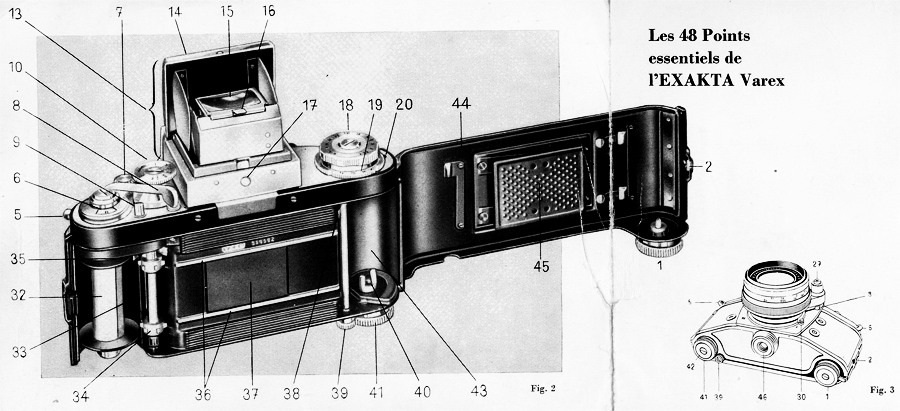
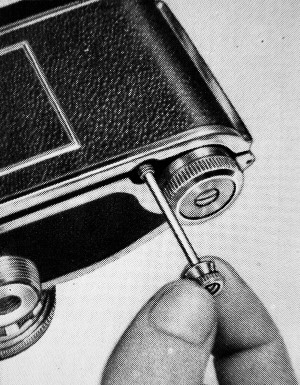
This blade can be seen on above on my photo where the back is open and for reference point please look the point 38 on the draft above. The operation is simple you have to screw out a lock at the bottom of the camera than you have to pull the rod and the blade cuts the film. I have never seen this before and while I am sure I will never use it, still it is a neat little feature. The engineers of Ihagee thought of everything.
Lenses and test shoots
Ihagee didn’t manufacture lenses by itself, but many brands made glass for the Exakta mount.
A very cool page to visit according to these lenses, in general, can be found here, and in detail with illustrations here.
I have got the camera with two lenses: a standard 50mm Tessar and a 100mm Trioplan. The Tessar had to get cleaned and lubricated, but the other lens is in a really nice shape.
Carl Zeiss Jena 50mm f/2.8
There is no Tessar written on the lens nor Carl Zeiss only Jena and a big “T” letter. The reason is that the East German Carl Zeiss Jena was not allowed to use it’s brand name nor the name of the lenses outside of the eastern block because the West German company owned the brand names. Nevertheless, this is a Carl Zeiss Jena Tessar lens and it performs as it should.
The Tessar is a classical construction or base type which consists of 4 elements 2 of them cemented together. These are considered very sharp and having a “hard” character (whatever it means). Because of the good performance, good enough speed and cheap production costs this lens type was very popular and have several siblings such as Elmar, Industar, Primotar, Skopar, Xenar, Ymmar, Ysaron, Belar etc. Apart from the direct relatives, there are many more modifications led to new lens families.
I am going to write a deeper article about this lens as soon as I can get an EOS to Exakta adapter.


Meyer Optic Trioplan 100mm f/2.8
This is a triplet structure anastigmat containing obviously 3 elements. Although the structure is very simple it allows a relatively fast aperture and also it has the advantage of having no risk to get glued elements separated as there are none of them.
Some of the brothers are Anticomar, Cassar, Novar, Meritar, Radionar, Trinar, Triotar, Voigtar, Eurygon.
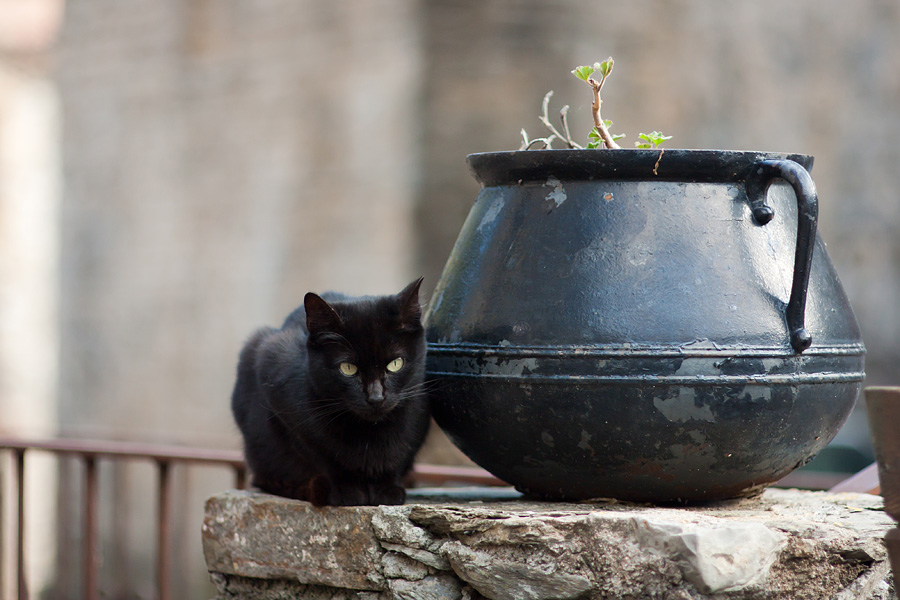
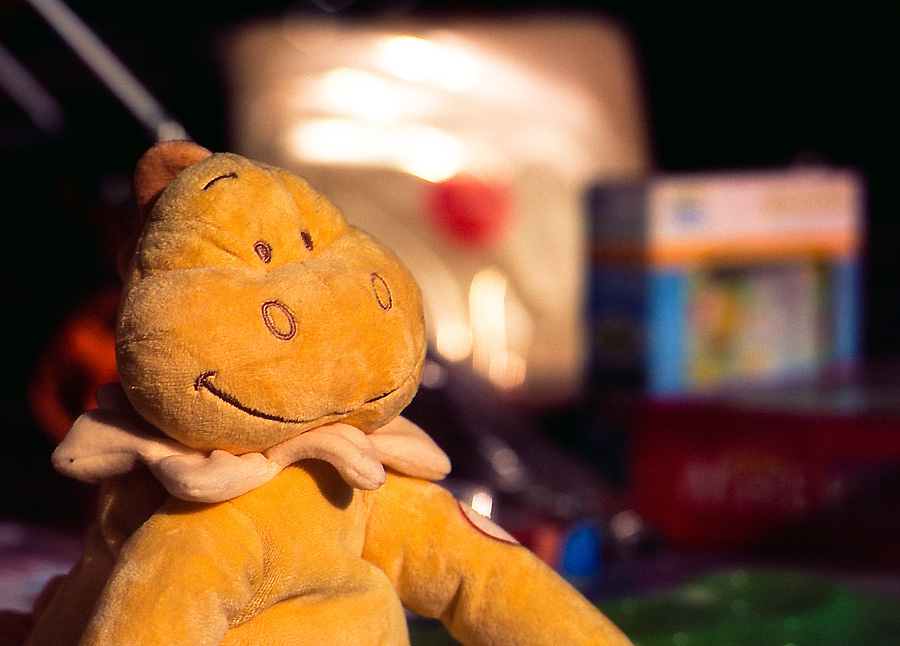
The triplet construction does not produce sharp images on large apertures due to the issues with the rays coming from sideways. This problem can be fixed on a level by stopping down. As you can see on the test photos the lens is indeed very soft wide open and it adds some kind of glow to the objects. It could even be beneficial for portraits by delivering a dream-like effect which hides most of the skin imperfectness of the model.
This lens is famous for its bokeh, which contains unusual and for most pleasing circles when shooting wide open. Unfortunately, I have no example taken by me so far, but you can see one here.
Again, I will do a deeper review of this lens as soon as I get an adapter to Canon and have some time to do more research.








 camerajunky
