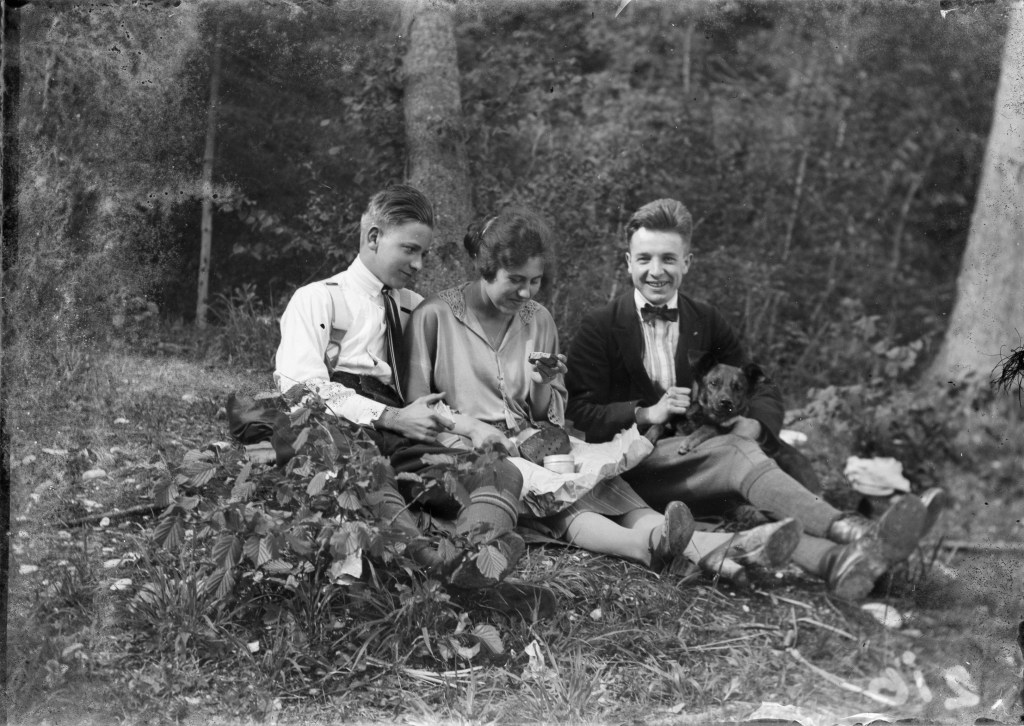
When we take photographs today especially on our phones we don’t consider them as historical documents. Photography is more ubiquitous than ever and for all likelihood our pictures will quietly rot away on a memory card or be deleted during routine maintenance in a dark corner of a nameless datacenter. Maybe they will become part of some AI as a minuscule fragment of the training set but never actually preserved. Besides who really thinks about mundane moments of life like a walk in the park with family as important in a historical context.
But when we take a random sample of 100 years of photographs, chances are that we found them quite interesting.
Of course photography was much less common due to cost, availability of gear and materials and the level of skill needed to take good pictures. People must have thought a bit longer before committing to pressing the shutter. Less photos were taken but those which survived to the present day are more likely to hold something special. The good news is that the medium of film and especially glass plates are quite resilient if kept in reasonable conditions. They are more likely to survive than anything on a hard-drive even though the jury is still out regarding archivability of digital media.
But I am already on a tangent, so let’s have a look at today’s subject which is a lot of 30 6x9cm glass-plates found by my father on a flohmarkt in Hungary.
Each of these photographs are stored in a paper sleeve with some text in German and the date 1923.


Such a find is always exciting to me. Not only that we can admire the quality of such old photographs, but we can get a glance into the past. Of course this is true with any photographs, but the fact that these are literally 100 years old and that the very silver on the glass witnessed these moments somehow makes the experience special.
I enjoy researching old photos and thankfully this time there are many leads to start on. On the paper sleeves there is the date of 1923 as well as the location. In some cases it is just the country, but other times the name of the city or a landmark. It is a bit hard to read the old style handwriting for me, but it seems that the photos are mostly from Germany (München, Herrenchiemsee) and somewhere from rural Hungary as well as a skiing at an unknown location.
The landmarks are easy to identify with the help of Google Image Search and it is real fun to check how these places look like today on Street View. In many cases there are archive photos can be found online from almost exact spots e.g.: feeding pigeons but from different years.
München


At Maximiliansbrücke I have fond a photo from almost the exact locations on Google Earth.


Herrenchiemsee


Herrenchiemsee is a complex of royal buildings on Herreninsel, the largest island in the Chiemsee lake, in southern Bavaria, Germany. Together with the neighbouring isle of Frauenchiemsee and the uninhabited Krautinsel, it forms the municipality of Chiemsee, located about 60 kilometres (37 mi) southeast of Munich.
Wikipedia
Hungary
To pinpoint exact locations is a lot harder for these pictures due to the lack of recognizable landmarks. But one sleeve has a text which I read as Csikéria, which is a small village at the south border of Hungary.


One thing is for sure, villages were a lot more different at the time as today. Parts of big cities with a bit of luck have survived largely unchanged the tides of the 20th century, but the rural world is quite a different story. The traditionally built houses made of adobe and covered with straw are gone a long time ago though they start to become fashionable again. There were hardly any infrastructure, only dirt roads, a well to take drinking water and a lonely telephone/power pole can be seen on the pictures. There are no automobiles seen apart from one example in München, but multiple horse carriages.

There is one picture with someone holding a newspaper with the title “A NÉP” (The Folk), but unfortunately there is not much more readable on it.


Clothing is another great source of information. For example there are a handful of pictures of a man wearing military uniform. The demarcations make it possible to identify nationality and rank. I will need to find some help regarding the identification, but it is likely to be a Hungarian uniform.
Skiing


The cross on the peak was/is very typical in the Alps, but it is not possible to tell where these photos were taken. I really enjoy looking at the details of their cloths, accessories such us glasses and pipe and skiing gear. No plastic can be seen here.
Trips and fun


Camera speculations
I would really love to know what camera/lens has been used to take these photos. We know that it took 6x9cm glass plates. It was released before 1923 and most likely by a European manufacturer. It is also likely that it was small and light enough to take it to adventures and shoot it handheld.
I imagine it mast have been a folder style camera from Voigtländer, Zeiss or from a similar brand. Like the Voigtländer Bergheil.

It might be able to guess the he camera model more accurately by the shape of the “film” gate and maybe based on the flare and bokeh characteristics of the lens, but for the time being I am only able to speculate.
Closing thoughts
There are many unknowns around these photographs. We don’t know who they are, if they were living in Hungary and had a chance to visit Germany or the other way around. We do not know what they did for the living. It is clear that they could afford nice cloths, activities such as skiing and not to mention photography.
There are recurring faces, but we have no idea if they were friends, family or anything else. One thing is sure, they were people trying to enjoy their lives in very turbulent times. The first World War was behind them, but they had to face a deep economic crisis and the next big war was just a few years ahead. In any case through these photos we got a little glance into their lives and we can reflect a bit about what has changed during 100 years.
My father told me that he may have some negatives left from the lot he bought. If I can get some more scanned or I manage to find out more about the pictures and there is interest, I may write a follow up to these post. If you’e found this interesting or you have some information (you recognise someone or a place, maybe have a better idea about the camera ), please write a comment.

 camerajunky
